The IPCC: Forty Years of Great Science in Understanding Climate Change
– by Dr. Wendell Chris King, Brigadier General, US Army retired
INTRODUCTION
What you have in front of you is an essay (or OP-ED) that will argue that the biggest threat to security and peace in the world today and in the future is Climate Change. It is both a science paper and an essay of personal beliefs formed through my study of the scientific evidence about climate change generated primarily by the United Nations Intergovernmental Panel on Climate Change (IPCC) and supported by many other sources as well. The essay evolved from a decision I made to prepare a new seminar to offer to whomever will listen, updating my views on climate change and the threats it poses to human security in an already very dangerous world. I am drawn to this effort by what I see as my split personality. I was a career military officer serving 36 years in an Army uniform. That was followed by 10 years as the Academic Dean at the US Army Command and General Staff College, the Army’s graduate school for career officers. We can call that part, my Mr. Hyde. My Dr. Jekyll personality comes from multiple advanced degrees in Environmental Engineering and teaching the discipline at the United States Military Academy and several other universities. My scholarly pursuits led me into a research area where the two personalities came back together, strategic environmental security; you will learn what that is shortly, but for now understand that Climate Change (CC) is a scientific subset of environmental security.
The work on the seminar carried me well beyond the point where the story could be told in one or two evening presentations. Also, many people who have attended my lectures before have asked about references and notes that would allow them to conduct their own studies and develop their own views (the hope of every teacher). So, asking your patience, what follows is my humble review and analysis of the more than 35 years of research into climate change produced by a world-wide team of scientists who dedicated themselves to making our world better through applying their talents to the study of climate change.
THE SCIENTIC HISTORY OF GROWING OUR UNDERSTANDING CLIMATE CHANGE
Shortly after, in geological time, the idea that the earth was round was adjusting thinking about our planet, but long before there was the science of meteorology, the great minds of the time past millennia were thinking deeply about why the earth’s climate was warm, and overall, how it really functions. In 1824 Joseph Fourier, most noted for his mathematical works, first proposed that the earth’s atmosphere worked much like a greenhouse in capturing heat in the atmospheric gases, thus making the planet livable. By 1896 Svante Arrhenius had confirmed Fourier’s theory when he developed his equation defining the relationship between atmospheric carbon dioxide levels and temperature; Work that earned him the 1903 Nobel Prize in chemistry. In 1958, Charles David Keeling established a carbon dioxide (CO2 ) monitoring station on the top of Mauna Loa volcano in Hawaii which became the primary source of data for tracking the relationship between world CO2 concentrations and atmospheric temperatures, which as the Arrhenius Equation predicts, CO2 concentrations are directly proportional to temperatures in the earth’s lower atmosphere. The first atmospheric computer model of weather and climate was not developed until 1967.
Two points come to mind from this brief history, 1) We really have not understood much about the chemistry and physics of our climate for very long, 2) It remains quite amazing how really smart people could just think deeply about complex problems, without the aid of the modern scientific tools, and through keen observation unlock the mysteries of our world. Where we stood in the 1980s can be summarized in Figure 1.
The Science and mathematics of Climate Change
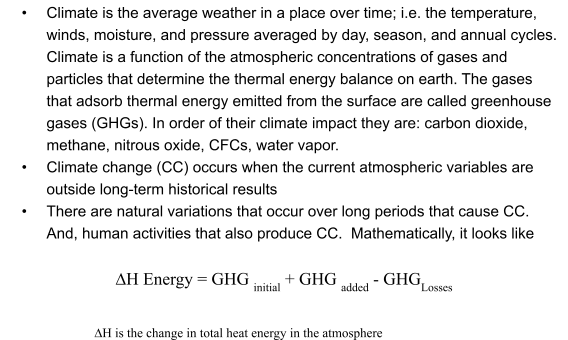
Figure 1
THE HISTORY OF CLIMATE CHANGE AS A SECURITY THREAT
Based just on this brief review of the historical development of climate science, it is unsurprising that the study of climate change as a security threat is also a relatively recent scholarly interest. It is nested in an area of study that was titled Environmental Security by its founders. These included distinguished scholars such as Norman Myers at Oxford, Marc Levy at Princeton, and Thomas Homer-Dixon at the University of Toronto. A great summation of these early works came in an article published in 1986 by Norman Myers in the Environmentalist when he summarized the concept in stating,
“Hence national security is not just about fighting forces and weaponry. It relates to watersheds, croplands, forests, genetic resources, climate and other factors that rarely figure in the minds of military experts and political leaders, but increasingly deserve, in their collectivity to rank alongside military approaches as crucial to a nation’s security.”1
This author in examining the application of environmental security theory within US defense strategic studies defined environmental security in stating,
“Environmental degradation and resource scarcity are of such a magnitude that they can become, if they are not already, an issue of national security for the United States.”2
By the 1990s the US Department of Defense had developed a position of Deputy Undersecretary of Defense for Environmental Security. A number of institutions and researchers were evaluating environmental issues such as water as a scarce resource, loss of arable lands, desertification, and other changes in the environment for their ability to threaten stability and security. In 2007, eleven 3 and four 4-star US General Officers from all services joined together to produce a seminal analysis of National Security and the Threat of Climate Change.3 Led by former Chief of Staff of the Army Gordon Sullivan, this report concluded that climate change is a severe threat to US National Security and must be considered in our National Security Strategy. (as you will see later, this report was issued at the time that the 4th Assessment Report was published by the IPCC)
Putting it bluntly, since that time it has been a swift downhill slide for environmental security within the strategic thinking of the US military. After appearing in several issues of the National Defense Strategy in the 1990s and 2000s, the current version of this primary official defense guidance document from the President makes no mention of climate change or any other environmental security threat as a security risk to the United States. We reached a free fall state as President Trump continues to proclaim climate change is a hoax promulgated by his political enemies. Executive orders have been used to destroy much of 30 years of progress in developing renewal energy sources and reducing air pollution. As I am writing today, it was announced that the EPA was rescinding the notice of endangerment it issued in 2009 which was the basis for regulation of CO2 emissions. This even though this rule had been reviewed and approved by the US Supreme Court at the time it was published.
INTRODUCTION TO INTERGOVERNMENTAL PANEL ON CLIMATE CHANGE (IPCC)
Created in 1988 jointly by the World Meteorological Organization(WMO) and the United Nations Environment Programme(UNEP), “the objective of the Intergovernmental Panel on Climate Change (IPCC) is to provide governments at all levels with scientific information that they can use to develop climate policies. IPCC reports are also a key input into international climate change negotiations.”4 This body rapidly grew to include 195 member nations participating in efforts to advance the body of knowledge of how the earth’s climate functions and if there is actually climate change being caused by human activity today. The first scientific report issued by the IPCC came in 1990.5 By 2023 the IPCC had issued its 6th Assessment Report (AR6).6 In addition to its 6 major reports the IPCC has issued a number of special reports to provide special emphasis for major findings and critical concerns discovered in their research.
The IPCC as a body does not conduct primary climate research. It functions by collecting research findings from scientists throughout the world which are then evaluated through a rigorous peer review process. The IPCC does guide the focus of research efforts in identifying gaps in knowledge needed to better understand climate change. The IPCC process has evolved and grown in capability throughout its history. It applies a risk-based approach to evaluating data and developing recommendations. An explanation of the process as it now exists with the 6 assessment reports follows shortly. All findings are reported with calculated confidence measures derived from the strength of the available evidence. Considering that more than 2,000 of the world’s experts participate in the IPCC process, their reports are some of the best reviewed science ever seen.
The primary purpose of this article is to examine the growth of climate change knowledge over the IPCC’s six major scientific reports. My bottomline up front is—Because of the superb efforts of the IPCC, we now know much more about how our climate and weather functions than we did in 1988. We are now able to make sound conclusions defining the impacts of climate change and recommendations for actions to mitigate and adapt for the protection of the whole world. This will be clear when you see the high degree of confidence the 6th Assessment Report attributes to its findings and conclusions. The last idea I hope the reader will take away from this introduction to the IPCC is a recognition that the IPCC process itself is a major good news story at a world scale. Over 2,000 respected scientists from almost every country in the world have worked cooperatively together for 38 plus years. They have been able to reach strong consensus on critical issues unbounded by political or governmental constraints to this cooperation. It is dangerously sad and a major failing for all humanity that their great good work has not been applied by governments with the same spirit of cooperation.
THE IPCC METHODOLOGY
Every scientific discipline employs journals, scientific meetings, and technical publications to announce and share findings that advance the body of knowledge in their discipline. The Peer Review Process for scientific acceptance of any new finding could be viewed as a large group of highly educated pessimists who are dedicated to proving the author(s) results are wrong. Only the best science passes the gauntlet of peer review. Climate denying organizations primarily funded by oil and coal companies continue to claim that IPCC scientists are in cahoots to rig the data, and human caused climate change is a hoax. Scientists just don’t work that way and certainly 2,000 scientists from 195 countries could never be convinced to agree on anything without the evidence being so powerful it is unequivocal. The confidence measures reported herein have improved greatly over the lifespan of the IPCC. The data herein will demonstrate that is a fact. A major conclusion of this essay is that the IPCC is the primary reason we have a much deeper understanding of climate change than when the IPCC began in 1988. The good science produced by the IPCC over its 38 years of inquiry now allows us to make critical decisions on what we MUST do to address the dire threats we face from climate change.
Critical to understanding the power of the IPCC is understanding how the confidence levels are developed. Figures 2 and 3 depict the basic process used to peer review each study that the IPCC evaluates, and each finding/ recommendation that goes into the reports.
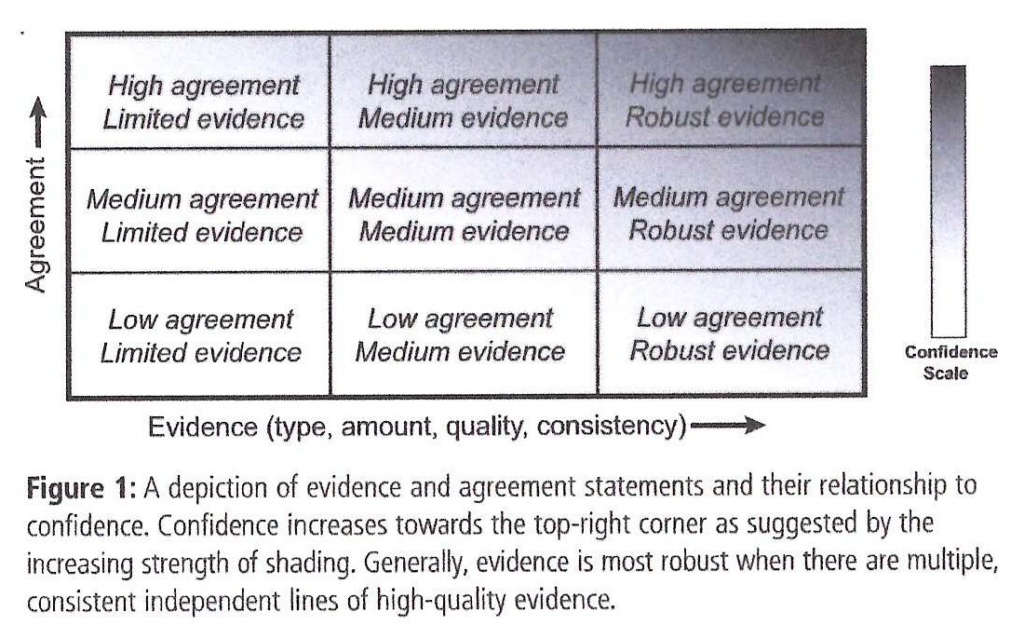
Figure 2
Source – IPCC, Guidance Note for Authors of AR5, July 2010
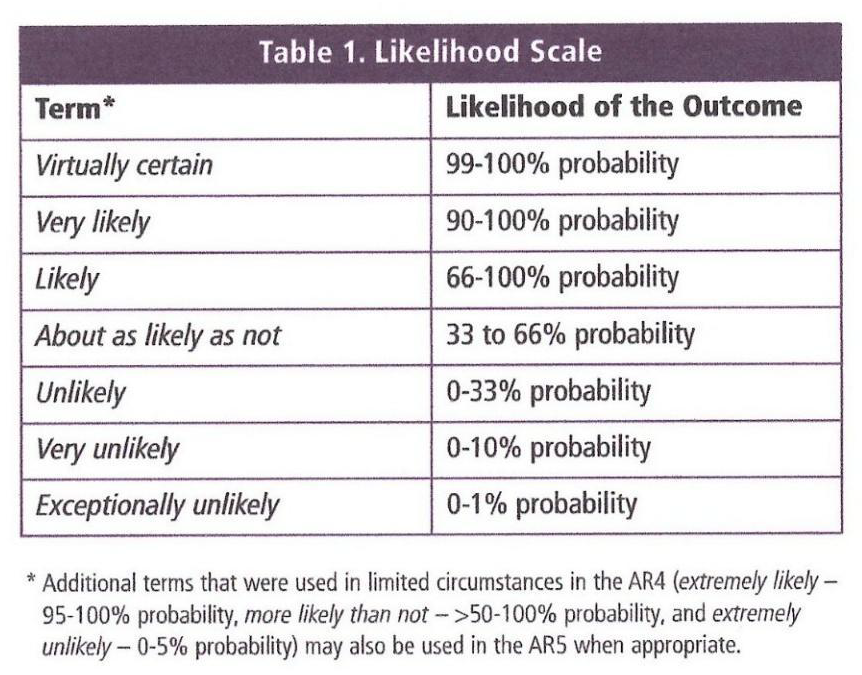
Figure 3
Source – IPCC, Guidance Note for Authors of AR5, July 2010
Applying these two figures begins with compilation of all reports that address a specific finding (rate of sea level rise as an example). As indicated in Figure 2, the more evidence that addresses a topic and the higher the agreement among those sources yields a high confidence/ probability that the finding can be trusted. A lack of supporting data, but strong agreement from limited research creates less confidence. It is important to understand that this approach is critical to appreciate the value of the IPCC process over time. It is the confirmation that comes from additional follow-on work that develops the confidence needed to become a finding for an IPCC report. This paper follows the history of the six ARs to evaluate the power of the methodology. Findings were presented in the early reports, but with lower confidence because of a lack of supporting research. One example from the 6 reports helps make this clearer. In the second report (AR2), one finding stated, ‘human impact in climate change is discernible’, that was 1995. By the time of the sixth report, 2023, the follow-on research has confirmed that, unequivocally, human activity is causing climate change and drives most of global warming. Nearly all rational scientists believed this was true in 1995, but the IPCC required further supporting scientific evidence to earn an unequivocal confidence rating. This demonstrates the power of the methodology to produce critical findings that are reliable. Unequivocal applies only to findings that are 100% certain.
The methodology of the IPCC continued to evolve over the period of the six primary reports. Early in the development process the format of the assessment reports became one of three separate sub-reports, each managed by a separate working group. The documents were organized as:
- Working Group I – The Physical Science Basis
- Working Group II – Approaches to Climate Change Mitigation
- Working Group III – Observed Impacts, Vulnerability, and Adaptation
The reporting process begins with the issuance of the Physical Science Basis. The findings of the science report become the starting point for Groups II and III to conduct their work. These two reports come some time later in the final reporting process. A critically helpful part of the IPCC methodology is that each working group produces a separate document titled “Summary for Policymakers” (SPM). This is very important to the utility of each report. Consider, a typical Working Group I report is thousands of pages. Working Groups II and III are not that size, but still hundreds of pages. The sheer volume of the report would overwhelm most senior decision makers. Further, these reports are drafted by scientists to share research among experts. Lay readers would struggle to gain the full importance of these highly technical full reports without the summary document. The SPMs boil the complex details of the science into useable findings and recommendations typically in 30 to 50 pages including graphics designed for non-science policy leaders.
It is critically important to recognize as we start discussing the IPCC research results that the unknown (independent) variable in predicting our climate future is knowing the mass of greenhouse gases (GHGs) that will be discharged in the future. You can understand the enormity of the problem we face just from looking at the units of this variable. GHGs emissions are measured in millions of tons per year being added to the existing concentrations retained by the atmosphere. How many billion tons more will be dumped into the atmosphere is a decision that humans will make based on set complex social, economic, and ecological factors? It will be the political will which will finally determine our future. Since the 1850s humans have continued to dramatically increase the annual discharge of GHGs into the atmosphere. These gases (see Table 1) led by carbon dioxide generated in energy production have long residence times in the atmosphere. There are natural sinks which through physical and chemical processes take GHGs out of the atmosphere, but not at rates close to what we add annually. (see Table 1).
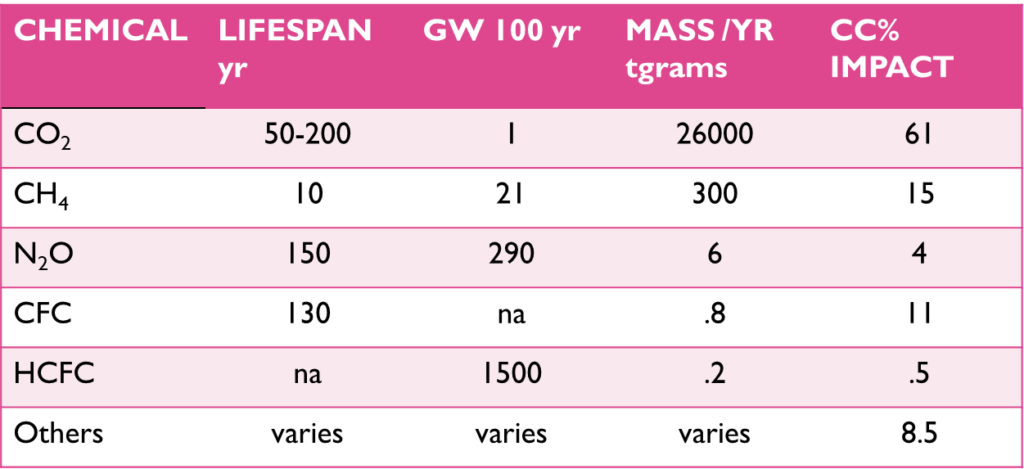
Table 1 – Primary Greenhouse Gases – Physical Data (Source – AR1, IPCC, 1990)
Current estimates show just over 50% of GHG emissions are being removed. This leads to the major conundrum in climate science, how to estimate future climate changes when we do not know how much GHG will be discharged in the future? The approach developed by the IPCC team is to analyze the futures for a grouping of emission levels. Typically, 5 levels are used that bracket the discharge rate at the time of the report. The median of the 5 levels is business as usual for the specific AR publication date. The highest two levels apply historic rates of increase for GHG emissions to estimate worst case scenarios. The lowest level is a calculated reduction in the discharges to reach an acceptable equilibrium temperature level in the future . For example, the number of gigatons of carbon equivalent (GtCO2 eq) of GHGs that would allow the temperature to stabilize at 1.5 oC by 2050. This allows the IPCC reports to analyze the mitigations and adaptations across the range of futures. Figure 4 demonstrates the strength of this approach in analyzing climate change futures. It shows the impacts on temperature for GHG emissions at best and worst case scenarios.
In summary of the IPCC process, it is completely appropriate to conclude that without the IPCC we would not have advanced climate science to where it is today. The magnitude of the threats hypothesized at the start of the IPCC brought the necessary resources to the research studies needed. The remainder of this report highlights what we have learned from the IPCC about our climate and its rapid changes in recent history, and what we can expect for our future, if we have one.
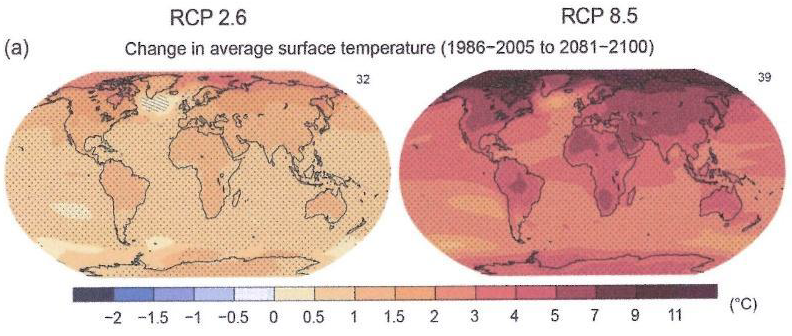
Figure 4 – Predicted Temperatures for Best and Worst Case GHG Emissions
Source – IPCC WGI AR5, SPM, 2013
Note: RCP = giga tons CO2 equivalents
MAJOR FINDINGS AND CONCLUSIONS FROM 40 YEARS OF IPCC RESEARCH
The story of climate change over the past 40 years has three interrelated goals: 1) what have been the actual measured changes in climate and can we develop models that effectively predict future changes, 2) how do those changes impact human security now and finally, 3) with, as will be shown, the IPCC assessment process proving to be predictive across a range of GHG emissions, what are the possible futures that will sustain human security through implementation of recommended mitigation and adaptation strategies? Our future will be determined by the way the world manages the emission and buildup of GHGs going forward. As shown in Table 1, the IPCC efforts have identified that past emissions will persist in the atmosphere for long periods producing unpreventable damage. These are the sunk costs of climate change today. Now we must find ways to limit future emissions or suffer a disaster of our own making through overwhelming the natural climate system with billions of tons more GHGs every year. The most impactful of these gases are carbon dioxide and methane. Though not as toxic or persistent as others, the IPCC work has shown unequivocally that the mass of these two gases discharged annually is the driving force of all climate change. Both these gases have natural sources, but the sources for the vast volume of annual discharges for both are anthropogenic.
The best way to appreciate the power of the IPCC process is to follow the major findings as they developed over time. Table 2 is a summary of all 6 of the assessment reports published by the IPCC. There are many metrics of how our climate is changing. In Table 2, this review will follow only those climate parameters which have been identified as having a major and lasting impact on human and environmental security. Those are the first 7 parameters in the left-hand column of Table 2, beginning with WARMING. The last two parameters in Column 1, Table 2, are metrics for specific questions fundamental to the purpose of the IPCC. The parameter Natural Sinks for GHGs follows how the IPCC advanced our scientific understanding of the natural system’s ability to remove GHGs from the atmosphere as GHG concentrations continued to increase. As the IPCC began its work, the general concepts of the sinks that impacted GHG concentration in the atmosphere were generally understood but not quantifiable. There was certainly no understanding how their effects would change as the land and oceans warmed, and the GHGs concentrations increased. We understood elements of the carbon dioxide cycle in our ecosystem, but the fate of carbon dioxide at much higher atmospheric concentrations and higher temperatures was unknown. For methane, one gigantic question still exists. The major anthropogenic source of methane is currently food production. We also must recognize that huge quantities of methane are sequestered in frozen soils in the Arctic, which are melting at the high rates with the warming in the polar regions.7 (See Figure 4) The IPCC data shows that the poles are warming at the fastest rates on earth, already exceeding several degrees centigrade above their historic levels dating back hundreds of thousands of years.8
The last climate change impact in Column 1 of Table 2 follows the growth of our understanding of the most contentious issue of the climate change debate — what part of climate change today is caused by natural processes and what part is a result of human activities? The IPCC began with a scientific certainty that the climate has always changed over time, but historically change occurred over long periods of time, thousands of years for large shifts. The work of the IPCC has yielded an unequivocal solution to this question — Nearly all of the warming measured over the last 150 years has been caused by human activity. This is seen clearly when you examine the last row of Table 2. Over the history of the IPCC, carbon dioxide has grown from 353 ppm to 430 ppm in 2025. In that time the earth has warmed by 1.09 oC with 1.07 oC unquestionably attributable to human activity. All credible research confirms the natural processes have NOT caused this rate or magnitude of change.
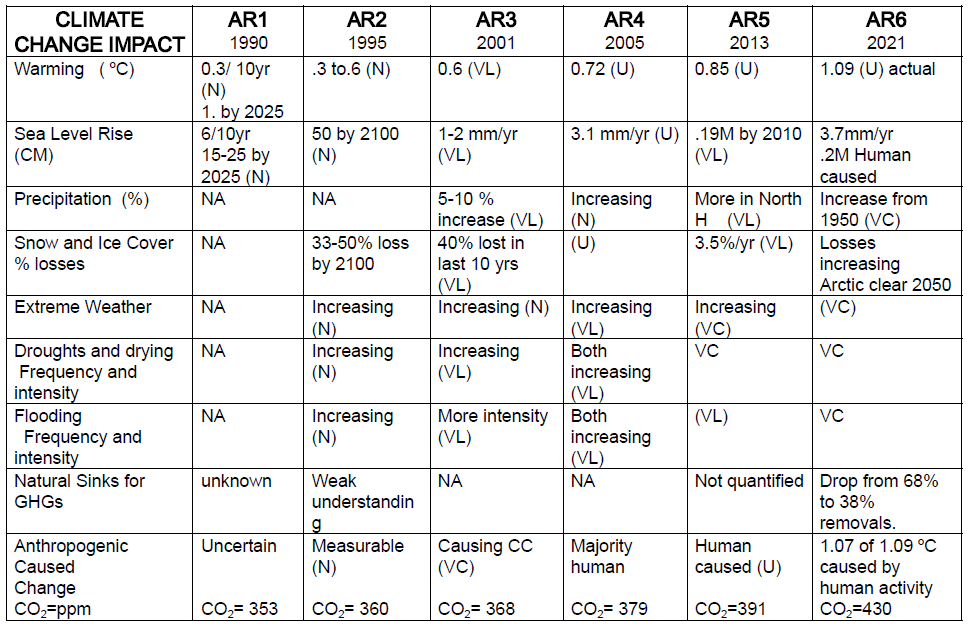
Table 2 – SUMMARY OF IPCC ASSESSMENT REPORT
Confidence Ratings
(U) = Unequivocal, (VC) = Virtually Certain, (VL) = Very Likely
(N) = Likely as not, (UN) = Unlikely, (NA) Not covered
Examining each row in Table 2 offers us a good picture of what the IPCC has added to our understanding of the earth’s climate processes. Warming has continued throughout the study period. This is not a surprising finding in that Arrhenius received the Nobel Prize for quantifying the relationship between carbon dioxide concentration and temperature in 1903. Sea level rise has two components, 1) warming water expands the volume of a mass of water, and 2) ice and snow melting off the land masses because of warming adds to volume in the oceans. The rates that these occur had not been well studied before the IPCC. The initial IPCC reports were therefore conservatively uncertain in the beginning. The AR6 report found with high confidence the rate of sea level rise was higher than initially predicted by the IPCC and that most of this rise was human caused. This was the largest deviation I found across the 6 reports and in this case the situation was worse than initially reported by the IPCC.
The changes in precipitation frequency and magnitude are much more complex to describe because they are heavily geographically dependent. Simple thermodynamics confirms that when more heat energy goes into the atmosphere there will be an increase in evaporation. As the IPCC process progressed more and more clarity was added to our understanding. By AR6 the IPCC was able with virtual certainty to predict climate change would increase the amount and intensity of precipitation for many areas of the world. Data now confirms that the temporal distribution of rainfall is being altered by warming. This then enhanced our ability to predict droughts and flooding would become likely because of climate change.
CONCLUSIONS
In summary of the science of the IPCC, the only evidence-based conclusion that any reasonable person can reach is that the IPCC process has been a tremendous success. It has answered the most critical questions needed to identify the causes of climate change, particularly focused on the last 180 years. It has provided the tools needed to assess climate change futures based on different scenarios of GHGs emissions. The best way I can think of to demonstrate this point is to go back to Table 2. Let’s focus on the first data point for AR1 and then the last data under AR6. We recall there was significant uncertainty as this process started. In AR1 the IPCC concluded that global warming would reach 1 oC by 2025, an estimate 35 years ahead. It rated confidence in this conclusion as likely as not. Now move to the last data entry under AR6. The actual warming in 2025 was 1.09 oC. So how well did the IPCC meet its mission? Unequivocally, the IPCC now provides the science needed to address climate change as a threat to human security. It has provided a process to apply this science to the range of possible outcomes based on a reasonable range of future GHG emissions. This process gives a science-based approach to measure impacts, examine alternative solutions to mitigate and adapt to climate change. Unfortunately, the IPCC also identified the unavoidable consequences we must live with from the GHGs already added to the atmosphere and which will persist for years to hundreds of years in the future.
Today, I am certain the single most important aspect of the climate change debate is creating the will to act on a global scale to save ourselves from the worst consequences of climate change. Well financed corporations campaign to deny, delay, and discredit any efforts to boldly step forward with action to save ourselves. In my judgment, the worst example of this has been the United States government which now, in the face of overwhelming science, continues to deny climate change is real. It boldly runs away from the fight by reversing all US regulatory efforts to reduce GHG emissions implemented for at least the last 20 years.
In my introduction I included a brief explanation of my personal focus on environmental security and its relationship with climate change. Now that we see through our examination of the good work of the IPCC data confirming the major climate changes that are occurring, I want to close by focusing on how climate change adversely affects human security. (I know I should also include how climate change helps human security: it doesn’t, at all.) Moving on, it has been my research hypothesis that any environmental changes that deny people their basic human needs create insecurity which leads to many bad results – including death, mass migrations, epidemic disease, famines, conflicts over scarce resources, and even war. Table 3 presents one way of looking at the cause/effect relationship between climate change and human security. A good way to think about Table 3 is to consider what you have observed in our world today. The science of the IPCC has shown that many of the disasters occurring around the world recently find roots in climate change. Like most things in earth science climate change never acts alone, but it is its interactions with the other laws of nature all intertwined with human activity which define the final impacts of climate change. Stated another way, climate change may not always directly cause harm, but can become the straw that broke the camel’s back in this dangerous, overcrowded world we live in. Military strategists refer to issues like this as “Threat Multipliers.”
China is now the largest emitter of GHGs in the world and continues to annually increase its emissions. India also is challenged to respond to its growing energy demand which is driven by the world’s largest population. I often use the Tibetan Plateau as an environmental security worst case example. Climate change is drastically impacting water resources for this region as ice and snow melt continues to accelerate losses driven by global warming. Nearly half the world lives in this region. Three of the countries possess nuclear weapons and 6 of the 15 largest militaries in the world are in the region, wonder why? They all depend on the 7 major rivers of the Tibetan Plateau for survival. This same analysis can be seen in areas all over the world. Climate Change and environmental security are both real; they present National Security threats to all nations. The IPCC’s work has also shown that the nations least able to defend themselves are often the most at risk. Dealing with CC is a world war and a long war because of the persistence of GHGs in the atmosphere. It is a war where we all win or we all lose.
From a global security standpoint, this author concluded that a world scale nuclear war may be a better alternative future for the world than the path we continue to follow in our unabated discharge of GHGs. I admit this is not a well-researched judgement, I leave it for your final consideration.
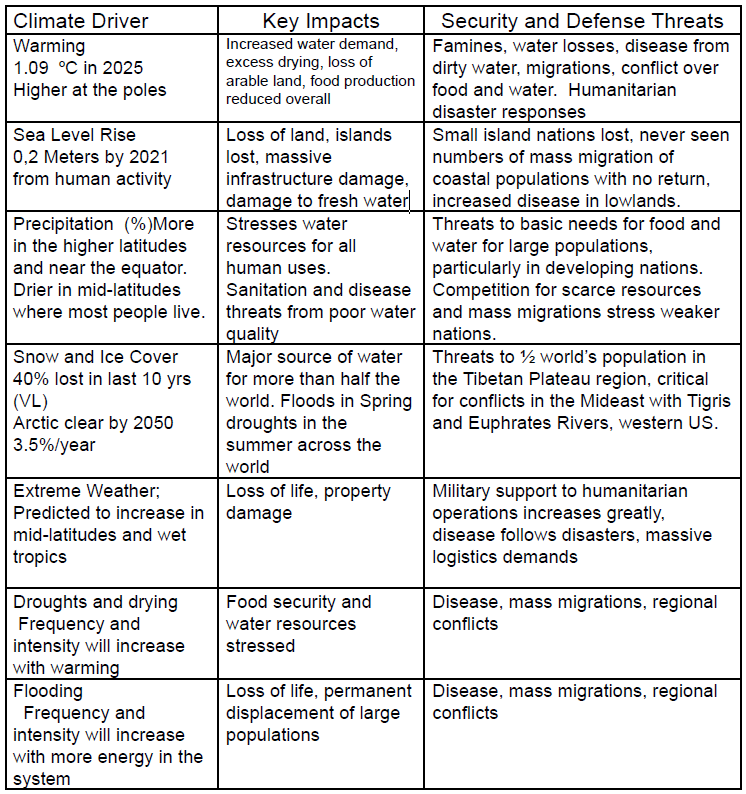
Table 3 – Key Impacts and Security Implications of Climate Change
References
- Myers,N. Environmentalist, 1986 ↩︎
- King, W., Army Environmental Policy Institute, No. AEPI=IFP-1100A, Nov 2000. ↩︎
- Center for Naval Analysis, “Security and Climate” 2007. ↩︎
- UNEP, https://ipcc.ch/reports, 1990. ↩︎
- IPCC, AR1, 1990. ↩︎
- IPCC, AR6, 2023. ↩︎
- Harvard Kennedy School, http:permafrost.woodwellclimate.org, 2026. ↩︎
- IPCC, AR6, 2023. ↩︎
Note: All IPCC Assessment Reports are available at the IPCC Website – Reports IPCC.